When I was a young girl, around seven years old, navigating a world that often felt too loud, too fast and too overwhelming, I didn’t know anything about nervous-system regulation, sensory processing or somatic healing. I just knew I needed somewhere quiet to step away from a confusing family environment.
I felt overstimulated and alone, so I created a magical sanctuary—a private world where I could comfort myself.
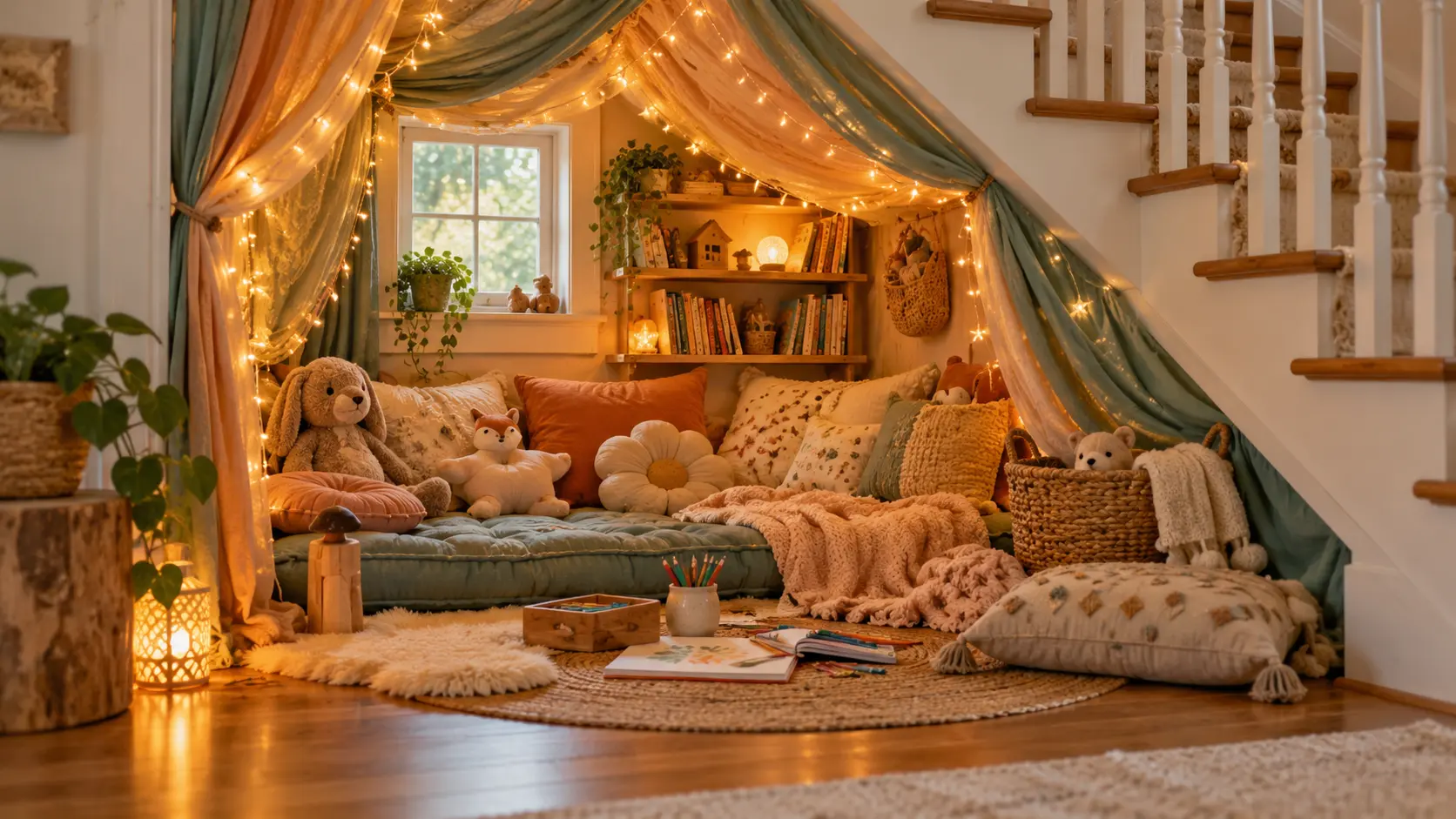
I would close the door to my little walk-in closet in our 1940s Spanish-style house in Southern California. I lived alone with my parents, with no siblings, and I often felt far too exposed to the world. I knew my parents had their struggles, and I realized that my closet was a perfect hideaway. I brought in a small lamp, my favorite blankets, stuffed animals, books, toys and small objects that brought me comfort.
Then, I would simply sit there for hours. I talked to my stuffed animals and watched the soft light reflect against the walls. I felt deeply safe and cozy. It became my refuge—a space where I felt safer than anywhere or with anyone else. What I didn’t know back then was that I was an empath, intuitively finding a way to settle my nervous system and create a safe harbor at seven years old.
We’ve Forgotten How To Be Still
Today, I look at the world around us and wonder if that instinct is something many of us have lost. We live in a culture that rarely invites us to simply be. Our phones are always within arm’s reach. Our calendars are packed. Our homes are filled with notifications, entertainment, advertising, background noise and endless demands to consume information and remain accessible to everyone. Even our moments of rest are accompanied by a screen.
Our children are growing up in this exact environment. There is always something to watch, somewhere to go, something to accomplish or someone to answer. We have become remarkably uncomfortable with empty space and silence. The moment a child says, “I’m bored,” we instinctively reach for a solution: an iPad, a television show, a game or an organized activity.
What if boredom isn’t something we need to fix? What if it is a doorway?
What if those empty moments are where our minds finally get the chance to wander, process, imagine and recover? What if settling into a sacred sanctuary is the very key to connecting with our most magical selves while giving our nervous systems room to breathe?
The Lost Art Of Doing Nothing
There is a profound difference between being passive and being still. Doing nothing, with intention, can be deeply restorative. When we step away from constant stimulation, we give ourselves space to notice what is happening within. Our breathing may slow. Our shoulders may drop. Our thoughts may soften. We may suddenly realize that we are tired, overwhelmed, sad or simply in need of quiet—all unfolding inside a space curated to reflect our authentic energy.
This is why practices such as meditation, time in nature, mindful breathing and intentional solitude can be so meaningful. Stillness creates space, and sacred environments reflect back who we truly are. This quiet allows us to hear what constant stimulation drowns out. Sometimes that voice is our intuition. Sometimes it is an emotion we haven’t had time to honor. And sometimes, it is simply the realization that we don’t need to perform at all.
A SMALL PLACE TO BEGIN
Download The Sacred Nook Starter Guide
Use five sensory layers to create a restorative corner in the space you already have.
Download the free guideYour Environment Is Part Of Your Well-Being
As an intuitive guide, trauma life coach and sacred-space architect, I’ve learned that healing doesn’t only happen through what we think or discuss. Our physical environment matters, too.
Consider how you feel when walking into a room that is harshly lit, cluttered, loud and chaotic. Now imagine stepping into a room with warm lighting, tactile textures, natural elements, quiet corners and an atmosphere where your body can finally exhale. The shift can feel immediate.
Our surroundings are constantly speaking to us, whispering: Hurry. Perform. Clean this. Answer that. Check your phone. Or, instead: You can rest here. You are safe here. Nothing is required of you right now.
That second message is what I want to bring back into our homes. For some, that looks like sound-softened walls and monochromatic tones with nothing more than a single cushion on the floor. For others, it is layered, tactile and rich.
The Sanctuary Doesn’t Have To Be Perfect
Creating a sanctuary does not require an interior designer, a dedicated meditation studio or an expansive home. A sanctuary can be remarkably simple. When I guide people in creating restorative pods or sacred spaces, I encourage them to begin with their senses: What feels like you? How does the room greet you when you walk in? How does the lighting feel against your skin? Is there a place where your body can completely let go?
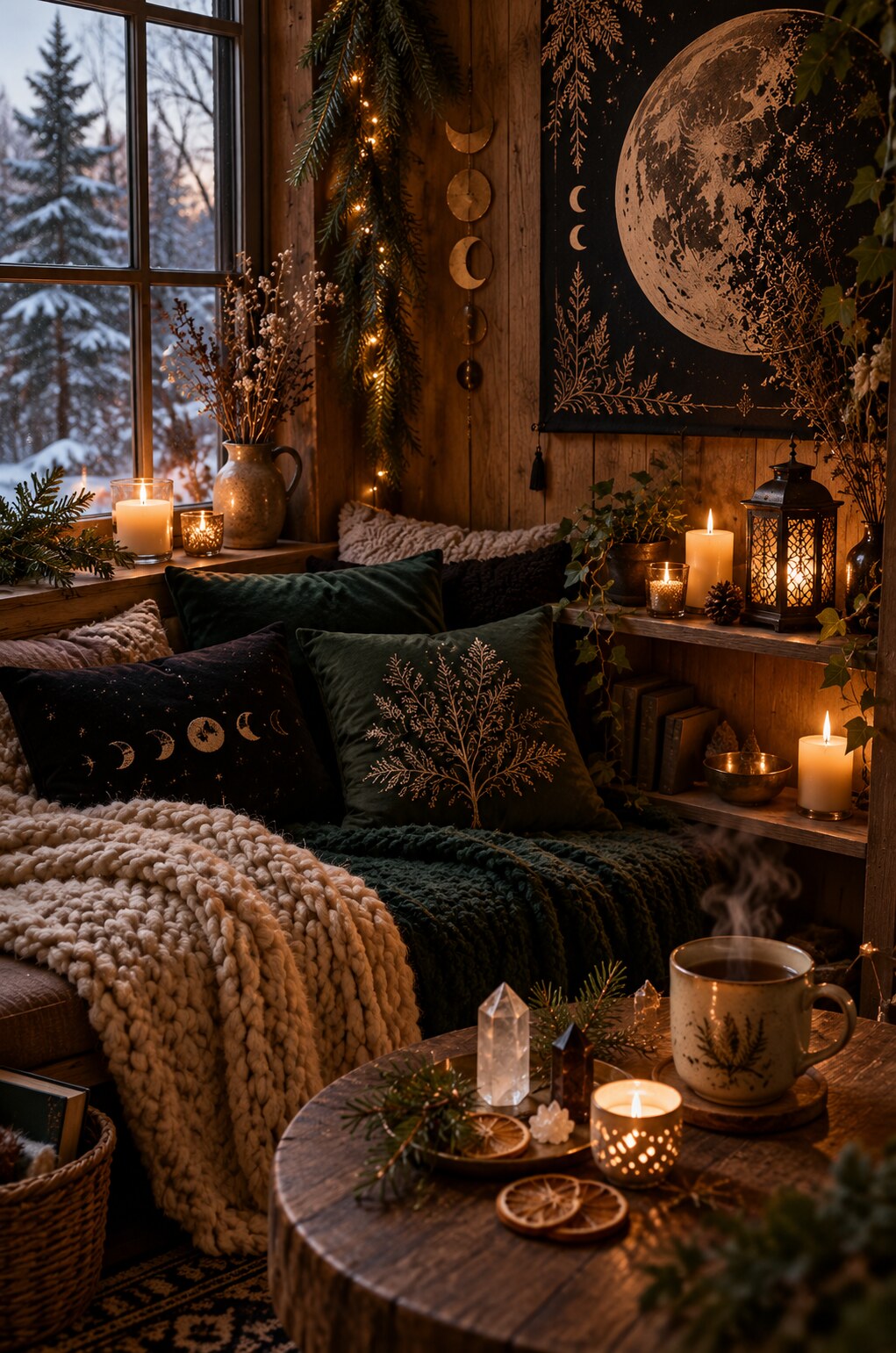
It could be a generous pile of blankets in a quiet corner, or a bathroom transformed into a plant-filled spa. It could be a reading chair by a window styled like a cozy mountain retreat in the middle of a bustling city. It might be a small tent in a child’s bedroom filled with warm fairy lights and their favorite treasures, or a collection of floor pillows arranged around an altar with crystals and salt lamps.
Even a simple hanging textile that carves out a personal nook—complete with a warm lamp, a candle and headphones playing a gentle soundscape—can transform your experience of the space. The goal is never a picture-perfect showroom. The goal is creating an environment that gives your body permission to soften.
The Child’s Sanctuary
Children need this concept now more than ever. Every child deserves a dedicated space where they can retreat without feeling that needing solitude is a punishment. It might be a cozy nook under a desk, a blanket fort, a deep window seat or a corner piled with floor cushions and books.
Most importantly: they do not have to produce anything there.
They don’t have to meditate. They don’t have to read. They don’t have to be productive. They can stare at the ceiling, sketch, hold a beloved toy, listen to music, breathe or be bored. They can simply exist. In doing so, we teach our children that stepping back is not a failure—it is an essential rhythm of being human.
Creating A “Zero Hour” At Home
One practice I love to introduce to families is what I call the Zero Hour. It doesn’t need to be sixty minutes; even twenty intentional minutes can change the atmosphere of an entire household.
Choose a window of time during the day when the home intentionally pauses. Phones are put away. The television is turned off. Chores are set aside, and expectations are dropped. Everyone is invited simply to be.
Adults can stretch, read, rest on the floor, step outside or sip tea. Children can draw, build, gaze out the window, cuddle a pet or retreat to their personal nook. The vital element is that the adults lead by example.
Children learn what rest looks like by watching us move through the world.
If they only see us rushing, multitasking and answering screens, they may internalize that frantic pace as the definition of adulthood. But when they see us put everything down and say, “I’m going to sit quietly for a while,” they learn an invaluable truth: I do not have to earn my right to rest.
The Heart Of Chakra Cozy
This philosophy lives at the center of Chakra Cozy, the seasonal publication, design ethos and lifestyle movement I co-created with Riz Mirza. It flows through our retreats, creative offerings and community gatherings. To me, Chakra Cozy is far more than styling a room. It is about crafting physical spaces that nurture the whole being—mind, body, spirit and senses.
It is about returning warmth, organic textures, soft illumination and authentic comfort to our living spaces. It is about designing environments that feel deeply personal rather than performative. Our homes should not merely be holding areas for our possessions or venues for entertaining others. Our homes are meant to hold us.
Let Boredom Become Beautiful
Perhaps the greatest gift we can offer our children—and ourselves—is permission to dwell in the open, unfilled moment. When your child says, “I’m bored,” resist the urge to step in with an immediate fix. Instead, try saying: “Good. Let’s see what comes up.”
Something almost always does: a story, a drawing, an insightful question, an imaginary world, a heartfelt conversation or simply a deep, grounding breath. And even if nothing comes up, that is perfectly fine. Often, doing nothing is precisely what our minds and bodies have been longing for all along.
Coming Home To Ourselves
That seven-year-old girl sitting in her California closet didn’t have the technical vocabulary to explain what she was doing. She didn’t know she was creating a somatic sanctuary; she simply knew her soul needed quiet.
I believe that knowing still lives inside each of us. We only need to quiet the noise long enough to listen to it.
Our homes do not have to be another stage where we perform. Our children’s days do not need every minute scheduled. And our rest does not need to justify itself through productivity. True healing often begins the moment we dim the lights, silence the phone, close the door and allow ourselves to do absolutely nothing.
Not because we have run out of things to do, but because, for a few sacred moments, there is nothing left to prove. There is only the quiet. There is only the breath. There is only you, finally coming home to yourself.
CREATE YOUR OWN NEST
Your Home Should Know How To Hold You.
Explore a sanctuary consultation, download a free guide or continue into the world of Chakra Cozy.
This essay shares personal experience and general well-being ideas. It is not medical or mental-health advice.